Verrazano made a snap judgment –
and got it wrong.
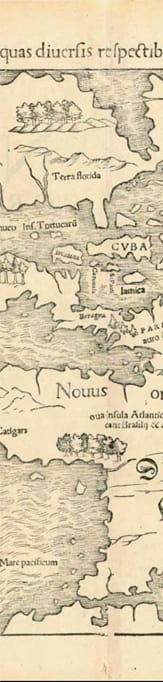
“Tabula Novarum Insularum,” the 1540 map created by cartographer Sebastian Münster, is one of the most influential maps of the Americas ever created. It was repeatedly printed in some forty editions over the next 100 years and that planted some of the imagery – and some of the myth – deep in the consciousness of generations of explorers.
But there is a mistake on the map, a myth that Münster mistakenly perpetuated. He took his data from Giovanni de Verrazano who sailed by the Outer Banks of Carolina in 1524.
Verrazano spotted the sounds, the open water, on the other side of those barrier islands and mistook this reach for the fabled Northwest Passage. European rulers and merchants ached for an alternative, shorter route to Asia (“the wealth of the Indies”); they would jump at any solution that seemed to lead in that westerly direction. Had Verrazano taken the time to investigate, he would have caught his mistake. Instead, because it was on the map, it influenced the thinking of everyone in the Western world for decades or more.
This is much like we see in the oil industry today…many companies are sold on quickie interpretations.
With so much data, companies can get misled by the fast look that may be pretty. Then they waste their valuable time and treasure (think manpower costs, rig rates, and so on) on completing zones that shouldn’t be tested, for example; or worse, missing productive zones that should have been identified.
Because of the errors, the Münster map didn’t lead to quick riches (but over a century or more, its value was immense.) Consider today’s more urgent opportunities for discovery: It’s important for companies to spend just a little time working their way to answers that are derived from good, proven science. That is when you can strike it rich.